
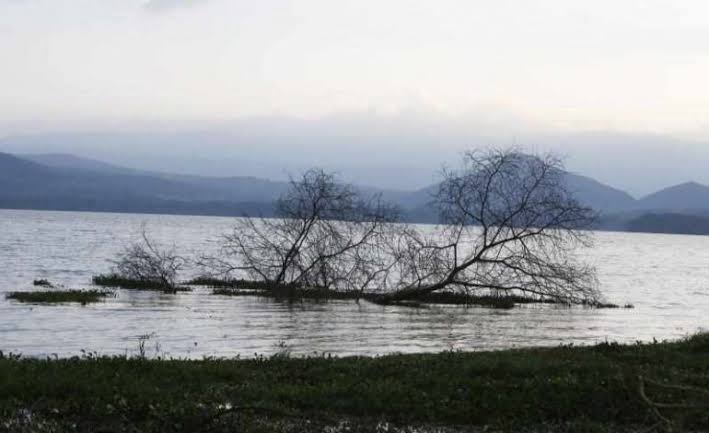
Residents told to leave as Lake Naivasha rises ahead of October rains
Residents of Kihoto estate in Naivasha have been urged to begin relocating from flood-prone areas as Lake Naivasha continues to rise ahead of the October–December rains.
The Naivasha sub-county public health department has identified Kihoto as vulnerable to further flooding and activated the sub-county disaster management committee ahead of the expected rains.
Margaret Mungai, the sub-county public health officer, said officials were preparing for a possible worsening of the situation as water levels around the lake continue to rise.
The warning comes as rising water has already flooded homes and public facilities in Kihoto, including schools, churches, a police station and part of a fuel pipeline. More than 5,000 people have been displaced from the wider Kihoto area during the recent flooding, according to local reporting.
Public health teams have been clearing blocked drainage and distributing water-treatment tablets as they prepare for further flooding. The disaster management committee has also mapped Mai Mahiu, Karagita and Nduro as areas vulnerable to flooding. No disease outbreak had been reported at the time of the latest warning.
The lakeside settlement has been at the centre of the Lake Naivasha flooding crisis since water levels began rising sharply several years ago.
Lake Naivasha had been rising since about 2018, according to research on the impact of the floods, and heavy rains between 2019 and 2020 turned the rising water into a prolonged disaster. Hundreds of people in Kihoto were displaced, while homes, roads, public services and livelihoods were lost as the water remained high for months.
The effects were not confined to flooded houses.
People lost businesses and rental income, while workers whose livelihoods depended on the local economy struggled after displacement. Research on Kihoto has documented the longer-term effects of the flooding, including unemployment and difficulties rebuilding livelihoods after residents were forced from their homes.
In March 2021, the Kihoto Homeowners Self-Help Group petitioned the National Assembly over the displacement caused by the rising lake.
Parliament subsequently investigated the situation as part of its inquiry into rising water levels in Rift Valley lakes.
The parliamentary process was supposed to lead to measures including relocation and compensation for affected residents and action to protect communities living around the lake.
But the water did not retreat permanently, and Kihoto remained vulnerable.
By 2025, thousands of residents were again being displaced as the lake expanded into homes and other parts of the settlement. Flooded toilets and rising concerns about sanitation and disease added a public health dimension to the crisis, while wildlife moved closer to homes and roads as habitat was inundated.
The crisis eventually returned to court.
In January 2026, the Environment and Land Court ordered the national and Nakuru county governments to implement the recommendations of the parliamentary committee on the rising Rift Valley lakes.
The court ordered the government to provide clean water, sanitation and medical supplies to displaced Kihoto residents and to formally begin a resettlement process by identifying safe alternative land for those affected.
It also ordered authorities to facilitate evacuation, assess and compensate eligible landowners whose property had been submerged or taken for the riparian reserve, remark the lake’s riparian boundary and establish a buffer zone.
A multi-agency task force was also ordered to oversee implementation, with the government required to report to the court every 60 days.
The latest warning therefore lands on a crisis that has already been investigated by Parliament and taken through the courts.
And the physical changes around the lake are substantial.
National Aeronautics and Space Administration (NASA) Earth Observatory reported in June that Lake Naivasha’s water level had risen by about seven metres since 2010, while its surface area had expanded by roughly 40%, adding about 50 sq km of water. Its satellite analysis showed the expanding lake reaching areas around settlements and infrastructure.
The rising water has also displaced wildlife. Hippos, buffaloes and giraffes have been pushed towards farms, homes and roads around the lake, increasing the risk of encounters with residents.
In November 2025, the Wildlife Research and Training Institute said rising water had inundated its Wetland Research Centre in Naivasha, forcing staff to move equipment and disrupting operations.
Scientists studying the wider rise in Rift Valley lakes have linked the changes primarily to rainfall and the lakes’ water balance. Research found that mean annual rainfall in the region increased by up to 30% between 2010 and 2020 compared with the previous period, while relatively small changes in effective rainfall were capable of producing substantial changes in lake levels.
NASA’s analysis similarly identified increased rainfall as the primary driver of Lake Naivasha’s recent rise. The lake is particularly sensitive to changes in its water balance because it is a closed basin with no surface outlet.
For Kihoto, however, the latest warning is about more than preparing for another rainy season.
Residents have already lived through displacement, lost homes and livelihoods, damaged public facilities and repeated disruption. Parliament has investigated the problem, researchers have documented its consequences and the courts have ordered the government to act.
Now, as October approaches, they are being told to prepare to leave again.