As COP31 nears, government faces test of climate finance and carbon markets
By Chemtai Kirui
The government says it needs KSh7.2tn ($56bn) to cut emissions and strengthen climate resilience by 2035, while tightening the rules governing carbon markets and pressing for more affordable climate finance.
NAIROBI – The government has capped the amount of emissions reductions that can be transferred to foreign governments and companies over the next five years, saying the limit is needed to protect the reductions required to meet its own climate commitments.
The cumulative ceiling is 10 million tones of carbon dioxide equivalent for international transfers between 2025 and 2030.
The cap is set out in the Kenya Guide for Strategic Engagement in Carbon Markets, launched on 5 October. The guide establishes how proposed activities will be assessed and authorized and how they should fit with national climate commitments.
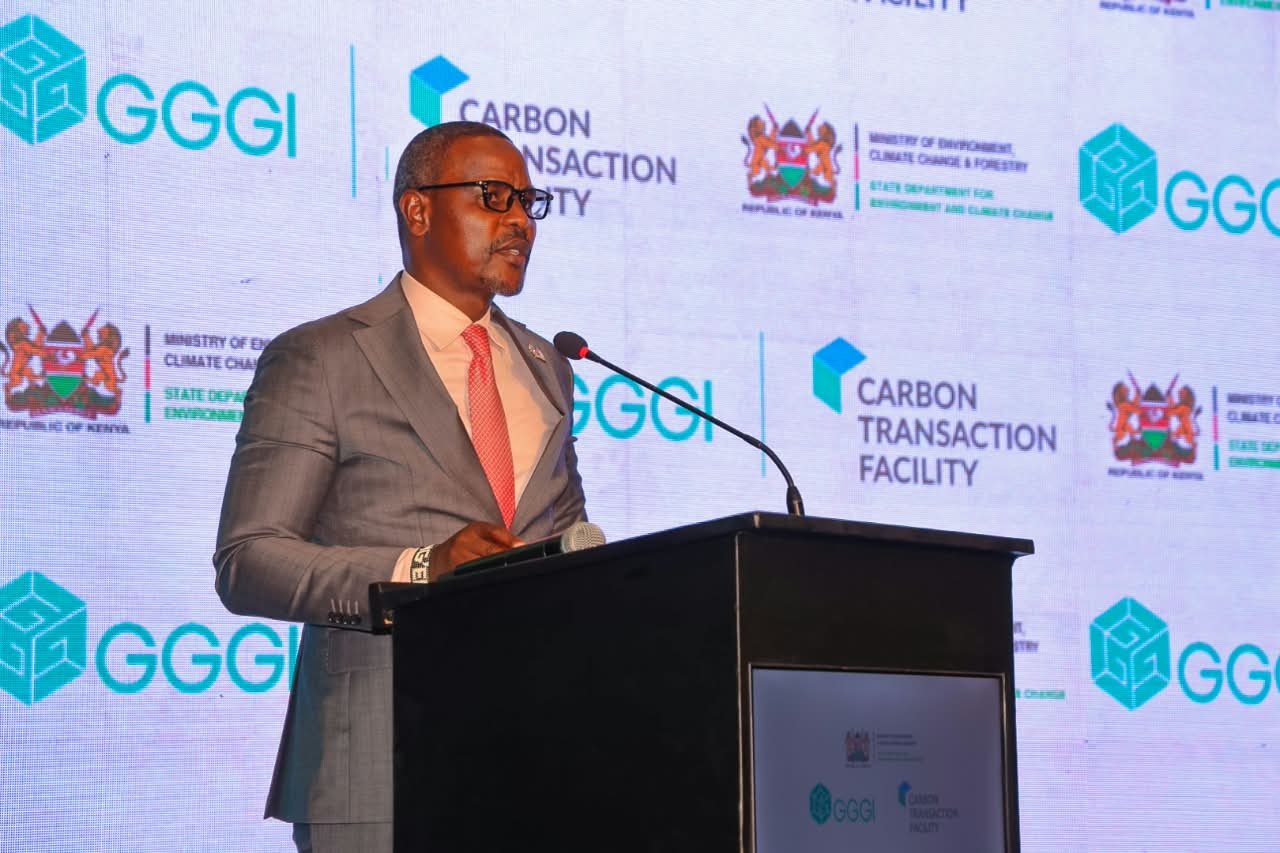
“For years, carbon markets were discussed as a future opportunity. That future is now here,” said Festus Ng’eno, principal secretary for environment and climate change.
The decision comes as the government seeks to finance a climate plan estimated to cost KSh7.2tn ($56bn) between 2031 and 2035.
The second Nationally Determined Contribution, or NDC, puts KSh2.9tn ($22.5bn) towards cutting emissions, KSh2.3tn ($17.7bn) towards adaptation and KSh2tn ($15.8bn) towards measures covering both.
The government expects to mobilize about KSh1.35tn ($10.5bn) domestically. The remaining KSh5.85tn ($45.36bn), about 81% of the total, is expected to come from international sources.
The European Union has committed KSh590m ($4m) to strengthen systems for monitoring, reporting and validating climate action and carbon projects.
The support is intended to improve the country’s ability to measure mitigation and report on climate action.
Climate finance received through loans is considered part of the country’s domestic contribution because the loans ultimately have to be repaid by taxpayers.
The government’s first Biennial Transparency Report, covering the reporting period to 2022, recorded KSh65.4bn ($507m) in climate finance. Of that, KSh6.7bn ($52m) was provided as grants and KSh47.1bn ($365m) as loans.
The government said those loans would count towards its contribution once repayments were made.
The KSh65.4bn figure is not directly comparable with the KSh7.2tn requirement in the second NDC because the two figures cover different periods and scopes.
The East African Community’s common position ahead of COP31 calls for climate finance that is predictable, accessible and grant-based.
The regional bloc is also calling for greater direct access to funding, more adaptation finance and support for adaptation and loss and damage without increasing the debt burden of vulnerable countries.
The position was endorsed at a meeting in Machakos from 29 September to 3 October.
More than four-fifths of the estimated cost of implementing the NDC is expected to come from outside the country.
An analysis by the Institute of Public Finance of adaptation-relevant programs in agriculture, rural and urban development, environment, protection, water and natural resources found that allocations had been declining and were highly unstable between 2018/19 and 2025/26.
In agriculture and related programs, annual adaptation-relevant allocations had fallen by nearly 90% from their peak by 2025/26. In environment, protection, water and natural resources, the decline was about 44%.
The analysis covers two groups of sectors and does not capture all adaptation spending. It also found substantial reliance on external financing.
External sources accounted for 58% of adaptation-relevant allocations in agriculture and related sectors and more than 80% in environment, water and natural resources in recent years.
At a pre-COP meeting held in Tuvalu and Fiji from 5 to 8 October, leaders and representatives from vulnerable countries called for a faster shift from climate commitments to action.
Fiji’s prime minister, Sitiveni Rabuka, told the leaders’ plenary that the declaration adopted at the meeting should make clear the need to turn knowledge and commitments into action.
“Our declaration must make our commitment to close the gap between what we know, and what we do, crystal clear,” he said.
On 6 October, participants adopted the Taku Pakasoa Declaration, calling for deep, rapid and sustained emissions reductions to keep the 1.5C temperature goal within reach.
The declaration calls on countries that have not yet submitted their 2035 emissions-reduction plans to do so and urges greater climate finance, particularly for small island developing states and least developed countries.
It also calls for grants and concessional finance for adaptation and reform of the international financial system so that vulnerable countries can access money at the speed and scale required.
Nepal’s foreign affairs minister, Shisir Khanal, told the meeting that countries faced different forms of climate vulnerability but shared a common interest in limiting the damage.
“Our vulnerabilities are not identical, but our stakes are shared, because the melting mountain ice adds to the rising sea,” he said.
The government has also established a framework for climate cooperation that does not involve transferring carbon credits.
The Climate Change (Non-Market Approaches) Regulations, 2026, gazetted in February under Article 6.8 of the Paris Agreement, provide for a national platform covering mitigation, adaptation, technology transfer and capacity building.
The regulations require attention to human rights, environmental safeguards and public participation, including free, prior and informed consent where activities involve community land.
In February, Barasa also launched the Kenya National Carbon Registry, intended to improve transparency, prevent double counting and track carbon credits and internationally transferred mitigation outcomes.
The new carbon-market guide sets out how proposed international carbon-market activities should be assessed and authorized.
The Financing Locally-Led Climate Action program, known as FLLoCA, provides one route for climate finance to reach counties and communities.
The five-year program, running from 2022 to 2027, has funding of about KSh38bn ($294m) and covers all 47 counties.
It is supported by the World Bank, Denmark, Sweden and Germany and is implemented by the National Treasury in partnership with county governments.
The program supports community-led projects, county climate planning and budgeting, water conservation, land rehabilitation, livelihood diversification and early-warning systems.
Its 2026 budget allocation is KSh8.9bn, compared with KSh11.5bn in 2025.
The program’s 2026 performance target lists 22 counties with operational County Climate Funds, compared with a target of 47 counties in 2025. The budget documents do not explain the change, so the figures alone do not show whether implementation has slowed.
The NDC targets a 35% reduction in greenhouse gas emissions by 2035 against a business-as-usual scenario.
It also includes measures to increase renewable electricity generation towards 100% of the national grid by 2035, alongside interventions in transport, clean cooking, agriculture, water, disaster preparedness and resilient infrastructure.
Meeting those targets is costed at KSh7.2tn ($56bn), of which KSh5.85tn (USD45.36bn) is expected to come from international sources.