Ruto signs infrastructure fund law to curb mounting debt
By Chemtai Kirui | Nairobi | March 9, 2026
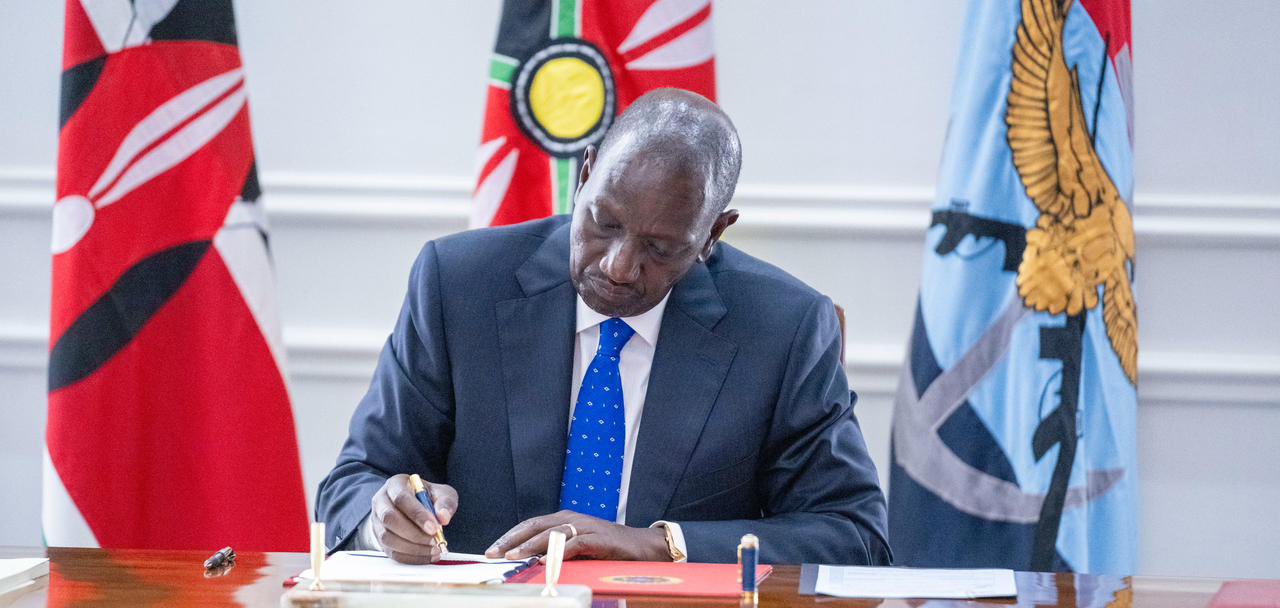
NAIROBI — President William Ruto on Monday signed into law the National Infrastructure Fund (NIF) Act, establishing a corporate investment vehicle designed to shift the country away from debt-heavy development toward a model financed by private capital.
The National Infrastructure Fund (NIF) is designed to mobilize an estimated KSh5 trillion over the next decade.
The move comes as the country grapples with a public debt stock that has surpassed KShs.12.1 trillion shillings, leaving the government with narrowing fiscal space to fund major capital projects.
Speaking at State House in Nairobi, Ruto said the fund would act as a primary vehicle for Public-Private Partnerships (PPPs), allowing the state to offload the financial burden of large-scale projects to institutional investors.
“We are charting a new path where our development is not defined by how much we can borrow, but by how much we can attract in investment,” Ruto said during the signing ceremony. “This fund will ensure that our infrastructure remains a catalyst for growth without compromising our long-term fiscal stability.”
The country’s infrastructure expansion over the past decade—including highways, ports, and the Standard Gauge Railway—was largely financed through external borrowing, particularly from Chinese lenders and international bond markets. Rising debt-servicing costs have since pushed the government to explore alternative financing mechanisms like the NIF.
Under the new law, the government seeks to attract private equity and pension funds to finance potential railway, highway, and energy developments.
NIF is explicitly prohibited from borrowing on its own balance sheet. Instead, it will act as a catalyst for Public-Private Partnerships (PPPs), where private investors take equity stakes in specific projects— such as major transport and energy infrastructure projects.
“This is not just a fund; it is a shield for the taxpayer,” President Ruto said at State House. “By ring-fencing privatization proceeds from state-owned enterprises into this fund, we ensure that every shilling of national wealth is reinvested into the next generation of highways and railways.”
Strict accountability measures have been embedded into the Act, including mandatory double-repayment and minimum five-year prison terms for the misappropriation of funds.
Government officials say the shift is intended to protect the national balance sheet from interest-rate shocks and currency fluctuations that have pressured the shilling in recent years.
However, the move to an investment-led model has drawn scrutiny from the private sector. Some economists say greater reliance on private investment could lead to more user-pay models, such as toll roads or tariff-based infrastructure, to ensure sustainable returns for investors.
The Act includes stringent oversight measures to address transparency concerns raised during the legislative process. The NIF is governed by an independent Board of Directors and a high-level Governing Council, with the law providing for severe penalties—including prison terms and heavy fines—for the misappropriation of funds.
The signing of the bill coincides with a pivotal moment for East Africa’s largest economy. Even as the government seeks to curb borrowing, it remains committed to massive regional projects, including the 300 billion shilling extension of the Standard Gauge Railway (SGR) to the Ugandan border, a project now expected to be funneled through the new NIF framework.
The government is expected to gazette the Fund’s operational regulations within the next 90 days. A first portfolio of projects slated for private investment is anticipated to be unveiled by the end of 2026.