The push to turn Kenya’s China trade into factories and jobs
Chinese imports reached KSh671bn last year while exports fell to KSh16.9bn. Now officials and business groups are trying to get Chinese manufacturers to produce more in Kenya
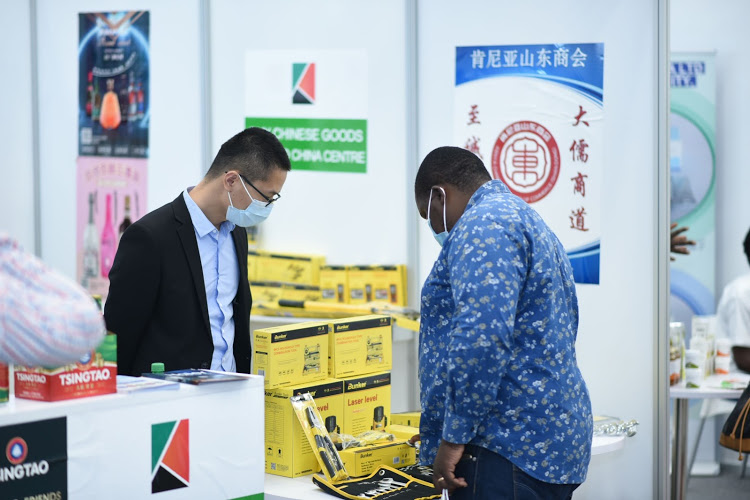
NAIROBI — Chinese manufacturers are displaying laser cutters, engraving machines, construction equipment and agricultural machinery at a Nairobi trade fair this week, pitching equipment that could help local businesses make more of the products they currently import.
The ninth Kenya International Industrial Expo and Kenya Investment & Trade Fair opened on Thursday at the Sarit Expo Centre and runs until Saturday. More than 300 companies are taking part, alongside an organised business delegation from Guangdong, one of China’s major manufacturing and trading centres.
The trade relationship between the two countries remains heavily weighted towards imports.
Imports from China rose 16.5% to KSh671.2bn in 2025, while exports fell 35.7% to KSh16.9bn, leaving a KSh654.3bn trade deficit, according to the Kenya National Bureau of Statistics.
Joseph Mutavi Kithu, national director of the Kenya National Chamber of Commerce and Industry, said the aim was to bring more Chinese technology into local production.
“We are going to bring more tools from China so that we can now start producing here in Kenya,” he said at the opening.
Kithu also urged Chinese companies to establish businesses locally, saying production here would make it easier to serve the market.
The distinction was being made by President William Ruto this week too. On Wednesday, he ordered a crackdown on foreign nationals engaged in hawking and other small-scale trading, saying such businesses should be left to Kenyan citizens.
He specifically referred to people coming from China to hawk or open small shops, while arguing that foreign investors should instead bring capital, create jobs and expand production. The government said enforcement would begin next week, even as Parliament considers legislation on businesses that could be reserved for citizens.
In April 2025, seven Chinese companies signed investment agreements during a Kenya-China investor roundtable in Beijing attended by President William Ruto and senior government officials.
In April 2025, seven Chinese companies signed investment agreements during a Kenya-China investor roundtable in Beijing attended by President William Ruto and senior government officials. The proposed investments covered manufacturing, apparel, agriculture and transport.
The automotive industry shows what some of that investment can look like.
Chinese-owned electric vehicle dealer Rideence Africa announced a KSh320m investment in an assembly line at Associated Vehicle Assemblers in Mombasa. The company planned to assemble electric hatchbacks from completely knocked-down kits supplied by Beijing Henrey, as well as electric vans from Jiangsu Joylong.
Rideence said local assembly could reduce vehicle prices by as much as 25%, helped by tax incentives for local assemblers. Its initial plan was to produce 132 hatchbacks and 20 vans.
Dongfeng has also announced plans to assemble passenger electric vehicles locally with AVA, while Tad Motors has launched locally assembled electric cars using Chinese-sourced components.
Officials are also pitching the market beyond Kenya’s borders.
The government is offering incentives through special economic and export-processing zones and is seeking to raise manufacturing’s contribution to GDP from 7.2% to 15% by 2027.
Pius Rotich, director of manufacturing sector investments at InvestKenya, said the policy and regulatory environment was being shaped to attract Chinese investment into local manufacturing, increase exports and narrow the trade imbalance.
At the expo, the machinery on display ranges from laser-cutting and engraving equipment to agricultural machinery, construction equipment, vehicles, solar systems and energy-storage technology.
Muhamed Swaleh, an entrepreneur visiting the exhibition, said he was looking for partnerships with Chinese companies supplying modern industrial machinery.
He said stronger links could help local businesses gain access to technology and technical knowledge.
The organisers are also trying to keep Chinese suppliers in the market after the exhibition closes.
Afripeak Expo, which organises the event with the Kenya National Chamber of Commerce and Industry and Kenya Investment Authority, calls the model “Front-Exhibition, Back-Warehouse”. The idea is for some Chinese suppliers to maintain local showrooms and warehouses, allowing businesses to continue buying machinery and supplies after the three-day event.
Gao Wei, Afripeak’s managing director, said Chinese companies needed to look beyond individual shipments.
“Selling one container of goods is a transaction. Building a partnership, transferring a technology, assembling or producing here, training local technicians and creating jobs, that is cooperation, and that is what lasts,” he said.
More factories would not by themselves solve the trade imbalance. The other side is finding products that can be sold into the Chinese market.
The government says China has granted approximately 98.2% zero-duty market access to Kenyan products under the Early Harvest Agreement, which became operational in 2026. Earlier trade negotiations identified tea, coffee and fish among the products that could benefit.
Tariff-free access does not guarantee exports. Producers still need enough supply, competitive prices and products that meet Chinese market standards.
The same applies to manufacturing investment. An investment agreement does not necessarily mean a factory is operating, and machinery displayed at a trade fair does not by itself create a production industry.
Factories operating locally, technicians trained to run them, domestic suppliers feeding production lines and products made here finding buyers in East Africa and beyond would show whether the strategy is producing more than trade-fair deals.
For now, the trade figures show why officials and business groups want Chinese companies to do more than ship goods into the market.