Aviation workers call off strike, but flight disruption lingers
After two days of cancelled and delayed flights, the dispute over pay and collective bargaining moves back to the negotiating table
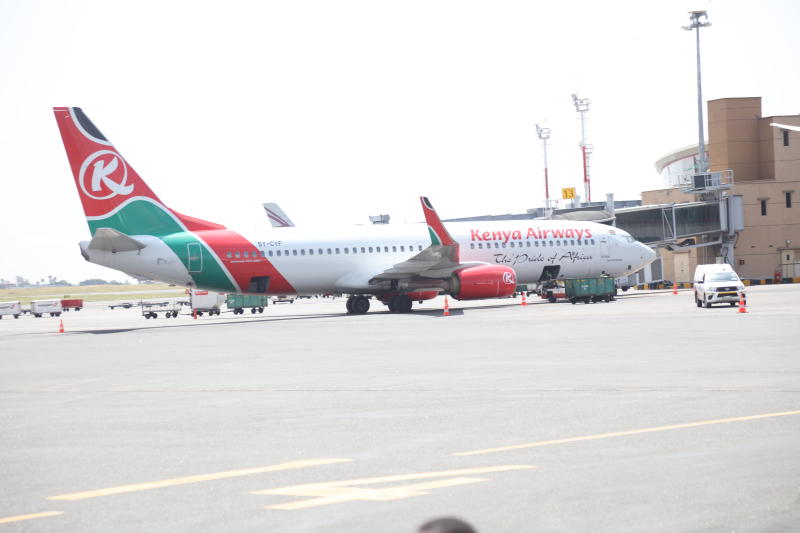
For two days, passengers arriving at Jomo Kenyatta International Airport have had to contend with cancelled flights, long delays and changing schedules as aviation workers stayed away from their duties.
On Tuesday, the strike ended.
But the disruption did not disappear with the signing of a return-to-work agreement.
The Kenya Aviation Workers Union (KAWU) called off the strike after reaching an agreement with the Ministry of Transport, the Kenya Civil Aviation Authority (KCAA), Kenya Airports Authority (KAA) and Jambojet, bringing the immediate confrontation between workers and their employers to an end.
KAWU secretary general Moss Ndiema urged workers to return to their stations and begin restoring normal services.
“We are simply calling off our strike action and pleading with our members to begin the process of normalizing operations, restoring services,” Ndiema said.
Airlines now face the task of working through flights disrupted since the industrial action began on Sunday, with passengers still being asked to check with their airlines as schedules are restored.
Kenya Airways said it expected normal operations to resume by Wednesday, although the airline warned that the effects of the disruption would take time to clear.
The strike had spread beyond JKIA, affecting operations at Moi International Airport in Mombasa, Eldoret International Airport and Kisumu International Airport.
For passengers, that means the end of the strike is only the first step. The flights that did not leave, the passengers who missed connections and the aircraft whose schedules were pushed back must still be fitted back into an already busy system.
And there is another backlog that cannot be cleared as quickly: the grievances that brought the workers to a standstill.
At the centre of the dispute are collective bargaining agreements that have remained unresolved since 2015.
Transport Cabinet Secretary Davis Chirchir said the agreement reached on Tuesday addresses three outstanding CBAs and creates a path for negotiations between the workers and KCAA.
The Salaries and Remuneration Commission has also withdrawn its earlier advisory issued on 28 July and issued new parameters to guide the negotiations.
KAWU has reservations about the new framework but agreed to use it as the basis for talks.
KCAA, meanwhile, has committed to negotiating in good faith and to honoring the outcome.
The agreement also deals with money and grievances that had become part of the dispute.
KAA is to immediately release and remit agency fees that had been withheld from the union. Outstanding grievances contained in KAWU’s 20 July strike notice will be taken through a structured process under the Principal Secretary for Aviation and Aerospace Development.
For workers who took part in the two-day action, the agreement provides protection against victimization, intimidation, discrimination or disciplinary action because of their participation.
The settlement does not, however, close every dispute.
KAWU’s separate fight with Jambojet over union recognition remains before the Employment and Labor Relations Court. The parties have agreed to await the court’s determination and abide by it.
The disruption at JKIA was felt not only by people waiting for flights.
Fresh-produce exporters also faced the prospect of delays to shipments of flowers, fruits and vegetables destined for overseas markets.
For an industry dealing in goods with limited shelf lives, a missed flight is not simply an inconvenience. A delay can mean a missed connection, a shipment arriving late or produce losing value before it reaches its buyer.
The concern is particularly significant at JKIA, where air freight is an important link between farms and international markets.
The two-day stoppage therefore exposed how much depends on an airport continuing to function even when the dispute behind the scenes is over wages, collective bargaining or union recognition.
Back to the negotiating table
The immediate crisis has ended, but the settlement leaves the government, KCAA and the union with work that cannot be resolved by a return-to-work order.
The outstanding CBAs must now be negotiated. The remaining grievances must be addressed. And the court will have the final say on the Jambojet recognition dispute.
For passengers, airlines and exporters, the more immediate question is how quickly the airport can clear the disruption left behind by the strike.
By Tuesday, workers were being asked to return and restore services.
The next test will be whether the agreement can keep them at work — and whether years of unresolved grievances can finally be settled without another shutdown.