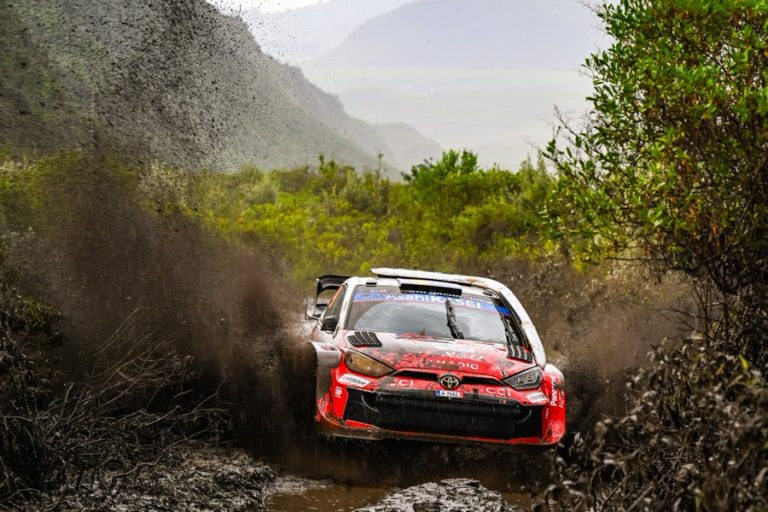
Solberg Takes Early Lead as Safari Rally Kenya Opens in Naivasha
By Chemtai Kirui| Naivasha| March 13, 2026
The 2026 edition of Safari Rally Kenya got underway on Thursday in the Rift Valley town of Naivasha, with rising rally driver Oliver Solberg taking an early lead after a demanding opening day that tested drivers and machinery in the first competitive stages of the event.
The rally, the third round of the World Rally Championship season, has shifted fully to the Great Rift Valley this year, with organizers basing the event around Naivasha rather than beginning with a ceremonial start in the capital Nairobi.
Teams are operating from a service park at the Wildlife Research and Training Institute complex, with competitive stages spread across the rugged terrain surrounding Lake Naivasha.
Solberg, driving a Toyota GR Yaris Rally1, emerged as the surprise leader after navigating the opening stages with precision while several top contenders struggled with dust and soft sand conditions.
“I gained much more time than I expected in the first stage,” Solberg said. “The conditions were tricky, switching from dry sections to mud and standing water, but we found a good rhythm.”
The Norwegian driver finished the day ahead of championship leader Elfyn Evans, also in a Toyota GR Yaris Rally1, with nine-time world champion Sébastien Ogier close behind.
French driver Adrien Fourmaux and defending world champion Thierry Neuville rounded out the top five after the first stages of the rally.
The opening day included a shakedown stage in the morning followed by competitive runs through the Camp Moran and Mzabibu sections, where drivers encountered deep “fesh-fesh” sand — a powdery dust that can obscure visibility and clog air filters.
Sudden rain during the Camp Moran stage also created slippery sections of mud and standing water, producing early time gaps between drivers starting at different positions.
Safari Rally Kenya is widely regarded as one of the most demanding events on the WRC calendar because of its rough gravel roads, unpredictable weather and the need for drivers to balance speed with mechanical preservation.
Unlike European rallies run largely on paved or smooth gravel surfaces, the Kenyan event features sharp volcanic rocks, loose sand and rapidly changing terrain that can quickly damage suspensions and tires.
“Car preservation” has long been considered a defining strategy of the rally, where drivers often slow down to avoid punctures or mechanical failures that could end their race.
The Safari Rally also carries a deep historical legacy. The event was first held in 1953 as the East African Coronation Safari to commemorate the accession of Queen Elizabeth II and later became one of the longest and toughest rallies in international motorsport.
Earlier editions stretched more than 5,000 kilometers across Kenya, Uganda and Tanzania, where simply finishing the race was considered a major achievement.
After disappearing from the world championship calendar in 2002, the rally returned in 2021 and has since been redesigned to fit the modern WRC format while maintaining its reputation for harsh conditions.
This year’s rally covers more than 350 kilometers of competitive stages over four days, though drivers say the shorter format has done little to reduce its difficulty.
The event has also drawn a strong local presence, with 17 Kenyan crews participating alongside international teams.
Among them is African rally champion Karan Patel, who leads the domestic challenge along with veteran driver Carl Tundo.
Organizers say the rally is expected to attract large crowds to the Naivasha region, with tourism officials projecting significant economic benefits for hotels, transport services and local businesses.
Tourism Cabinet Secretary Rebecca Miano said hotels in the Naivasha area had reached full occupancy ahead of the rally’s start, illustrating the massive pull the event exerts on regional commerce.
The event is projected to inject billions of shillings into the economy while drawing international television audiences to Kenya’s landscapes.
Corporate sponsorship has also grown in recent years as the government encourages greater private-sector participation in hosting the rally.
Companies including KCB Bank Kenya and CFAO Motors Kenya have contributed funding and logistical support for the event.
Drivers will continue with additional stages across the Rift Valley on Friday as the rally moves deeper into some of its most challenging sections.
With changing weather conditions and punishing terrain still ahead, teams say the early leaderboard could shift quickly as the competition intensifies over the coming days.