KCSE 2025 results released as nearly one million candidates await next steps
By Chemtai Kirui
Results mark one of the final cohorts under the 8-4-4 system as placement and funding decisions loom
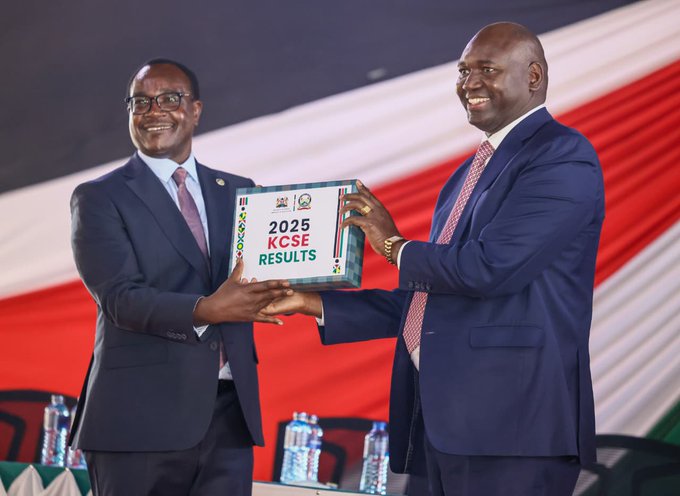
Nairobi, Jan. 9 — The government has released the 2025 Kenya Certificate of Secondary Education (KCSE) examination results, marking a defining moment for nearly one million candidates and their families as the transition to post-secondary education begins.
Education Cabinet Secretary Julius Ogamba announced the release during an official briefing, saying the outcomes reflect performance trends shaped by curriculum reforms, school preparedness and learning conditions during the ongoing transition toward a competency-based education framework.
According to the Ministry of Education, about 996,000 candidates sat the national examination in centres across all counties, making the 2025 KCSE among the largest cohorts in recent years.
The KCSE results determine admission to universities, colleges and technical institutions, as well as eligibility for government sponsorships, scholarships and other post-secondary opportunities.
The Kenya National Examinations Council (KNEC) said marking was completed on schedule following weeks of evaluation by contracted examiners, under enhanced integrity measures aimed at safeguarding the credibility of the national assessment.
The announcement was made at AIC Chebisaas High School in Eldoret during a ceremony attended by senior education officials and sector stakeholders.
How candidates can access results
Candidates can access their results through official KNEC channels, including the online portal, results.knec.ac.ke, and designated mobile platforms.
Schools have also been issued with guidelines on downloading and disseminating results to students.
Education officials urged candidates and parents to use only official channels, warning that scammers often emerge after results are released, falsely claiming they can change grades or fast-track college placements for a fee.
Ogamba said the results of 1,180 candidates were cancelled after they were found to have been involved in examination irregularities, meaning they will not receive valid KCSE results.
Performance patterns and disparities
Official figures released alongside the results show that about 270,000 candidates — roughly 27 per cent of the cohort, attained a mean grade of C+ and above, qualifying for direct university entry.
A total of 1,932 candidates scored straight A’s in the 2025 KCSE, up from 1,693 in 2024.
The number of students scoring C- and above also increased compared with last year, reflecting modest overall performance gains.
Girls accounted for about half of the candidates who sat the national examination.
Previous KCSE cycles have consistently shown stronger performance in better-resourced schools, while institutions facing constraints in infrastructure, staffing and learning environments continue to struggle.
Education analysts say early patterns in the 2025 KCSE results are consistent with previous cycles, where national and extra-county schools tend to account for a larger share of top grades, while county and sub-county schools record more modest outcomes, reflecting ongoing disparities in resources, infrastructure and teaching capacity.
“The KCSE results are not just a scorecard for individual learners, but a reflection of broader systemic strengths and gaps,” said an education policy analyst, noting the importance of interpreting outcomes beyond headline grades.
Transition to higher education and training
With the results now out, attention shifts to placement into universities, teacher training colleges and technical and vocational education and training (TVET) institutions.
The placement process, coordinated by the Kenya Universities and Colleges Central Placement Service (KUCCPS), is expected to open in the coming weeks.
The government has continued to encourage students who may not qualify for university admission to consider TVET pathways, citing growing demand for technical skills in construction, manufacturing, energy and digital services.
For many families, however, the transition comes with renewed financial pressure, as households prepare for tuition fees, accommodation costs and other post-secondary expenses at a time when living costs remain elevated, according to household spending trends.
Renewed pressure on the education system
The release of the KCSE results has also revived debate around education reforms, teacher workload and school funding.
Teachers’ unions have repeatedly raised concerns over staffing gaps and rising class sizes, while parents have pointed to persistent inequalities between public and private schools.
Beyond individual outcomes, the 2025 KCSE carries added significance as the country moves closer to the full transition away from the 8-4-4 education system. The cohort is among the final groups to be examined under a structure that has shaped secondary education for more than three decades.
The examinations were conducted during a period in which two education systems are running concurrently, increasing the logistical complexity of exam administration.
KNEC described the 2025 cycle as one of its most operationally demanding in recent years, with thousands of personnel deployed nationwide to manage examination centers, supervision, security and transport.
The 8-4-4 system formally ended in November 2025, placing the current KCSE cohort among the last students to be assessed under a framework that has defined generations of Kenyan learners.