A Grave That Kept Growing in Kericho
By Chemtai Kirui| 25/03/2026
Kericho – A day after the exhumation of 33 bodies at Makaburini Cemetery shocked the country, investigators are now confronting deeper questions about how dozens of remains—many of them children—were buried in a single trench with limited documentation.
It began quietly. A white Land Cruiser. A group of gravediggers called in before dawn. The job was unusual: not the careful digging of individual plots, but a single, wide trench cut into the red soil.
By sunrise on March 20, black body bags were being lowered into it. No ceremony. No names.
Days later, when detectives from the Directorate of Criminal Investigations (DCI) arrived, they expected a paperwork issue — a routine lapse in procedure. Instead, they found a grave that kept expanding.
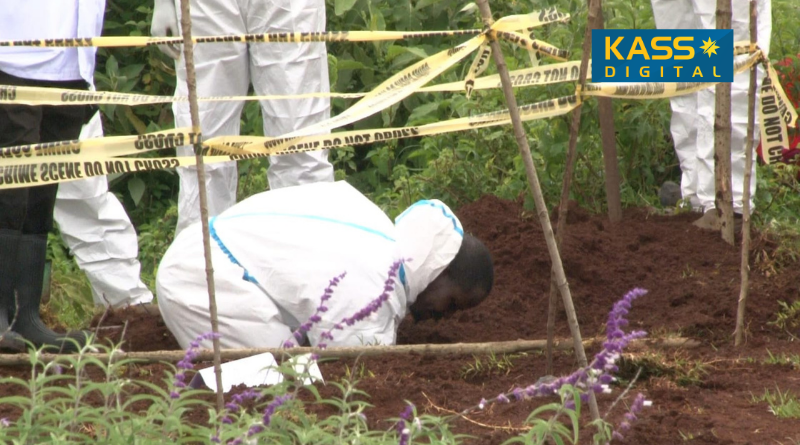
At first, there were said to be 14 bodies. Then more. By March 24, forensic teams had pulled 33 from the pit.
Twenty-five of them were children.
Eight were adults.
There were also six dismembered limbs, catalogued separately, now lying in mortuary drawers awaiting identification. For pathologists, the task is no longer just counting the dead, but trying to understand how they ended up here — whether this was a single event, or something more fragmented, more deliberate.
The official explanation is administrative.
According to DCI Director Amin Mohammed, the bodies were “unclaimed remains” transferred from Nyamira District Referral Hospital for burial. No violence. No crime scene. Just a system clearing its backlog.
But the ground tells a different story.
A photocopied court order recovered from the home of the cemetery’s caretaker authorised the burial of just seven bodies. Thirty-three were found.
The gap is not marginal. It is a 470% discrepancy — between what the law permitted and what was done.
Then there is the condition of the remains. Some were heavily decomposed, consistent with long-term storage. Others appeared recent. The mix suggests not a single transfer, but possibly multiple disposals — bodies arriving at different times, ending up in the same trench.
Detectives have since impounded the Land Cruiser believed to have transported the remains. They are now tracing a route that appears to have crossed county lines without triggering the checks required under Kenyan law.
Because, in theory, there are safeguards.
Under the Public Health Act, unclaimed bodies cannot simply disappear into the ground. Hospitals must hold them for weeks — sometimes months — while issuing public notices in newspapers and broadcast media. Families are given a chance to come forward. Only after that can a court authorise burial. Even then, the process is supervised, documented, recorded.
At Makaburini, much of that chain appears to be missing.
Investigators say they have yet to find evidence of the required public notices for the 33 individuals. The court order on record accounts for only a fraction of the dead. The rest — including most of the children — remain outside the paper trail.
Two men are now in custody.
David Araka Makori, a public health officer from Nyamira, and Richard Towett, the cemetery caretaker, have been remanded for 30 days as detectives investigate possible charges ranging from neglect of duty to conspiracy to defeat justice.
For now, the case sits in an uneasy space — somewhere between bureaucratic failure and criminal intent.
Nyamira County officials have distanced themselves, suggesting the transfer may have been an unauthorised arrangement rather than a sanctioned process. Human rights groups, including HAKI Africa, are calling for independent post-mortems, wary of local interference.
Meanwhile, the work continues in Kericho.
Forensic teams are preparing DNA samples. Each body must be identified, if possible. Each limb matched. Each timeline reconstructed.
The questions are multiplying.
If these were hospital deaths, where are the records? The death certificates? The public notices? Who authorised the transport? Why a private religious cemetery, rather than a gazetted public site? And why at dawn?
Most pressing of all: who were the 25 children?
The answers may lie in hospital files, in court registries, or in the digital trail of a single vehicle. They may also lie with officials yet to speak.
Until then, the trench at Makaburini remains open — not physically, but as evidence.
A place where the state’s systems appear to have broken down, and where the dead, for now, outnumber the explanations.