
THE GHOST IN THE BAMBOO
In the high, thin air of Mount Kenya, a conservation effort aims to return the critically endangered mountain bongo to forests where it once thrived.
By Chemtai Kirui| Nairobi | March 12, 2026
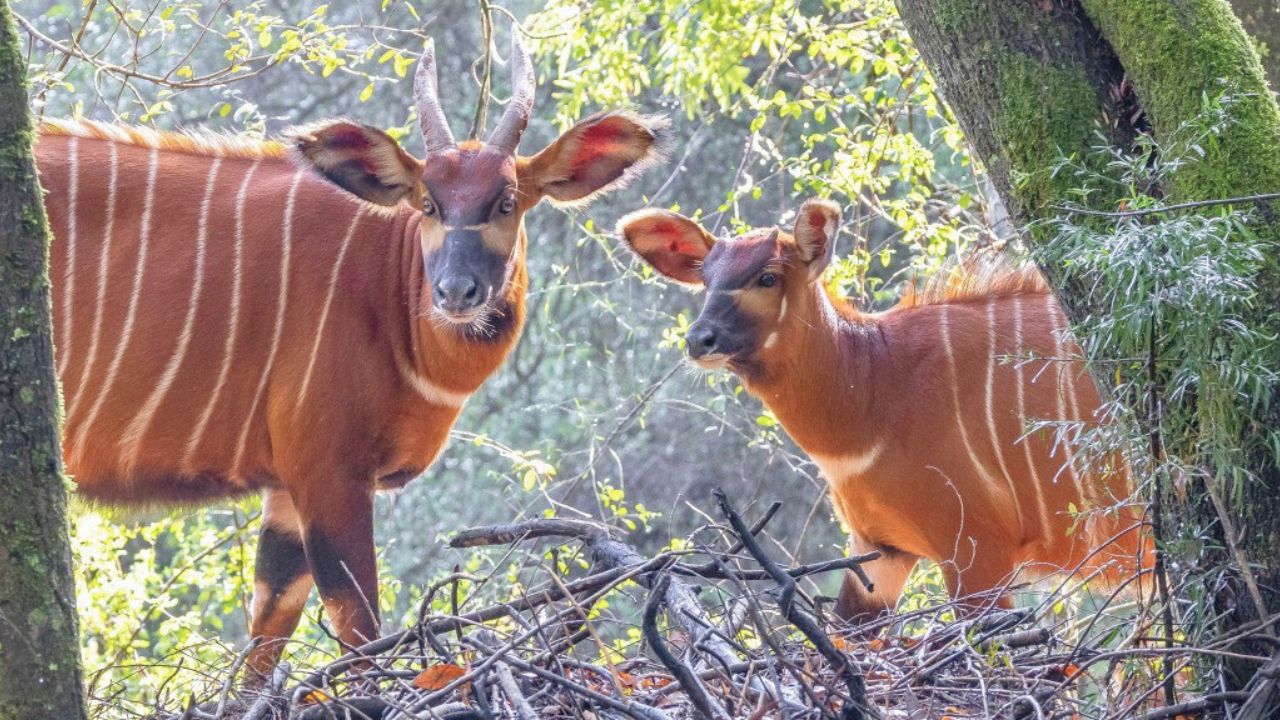
There is a particular kind of silence at nine thousand feet on the southwestern slopes of Mount Kenya—a damp, moss-covered quiet that hangs over the bamboo forest. For decades, that silence has been absolute, at least in regard to the mountain bongo (Tragelaphus eurycerus isaaci), one of Africa’s rarest antelopes. Once common in the Ragati-Chehe bamboo thickets, the species is now critically endangered, with fewer than sixty-five individuals believed to remain in the wild.
On Wednesday, at the Karura headquarters of the Kenya Forest Service, a group of conservationists signed a document intended to begin restoring the species to its former habitat. The Ragati Chehe Mountain Bongo Conservation Trust—a coalition of the Rhino Ark, the Mt. Kenya Trust, and international partners like the Wilder Institute Calgary Zoo—formalized a fifteen-year Special Use Licence.

It is a modest piece of forest for such an ambitious conservation effort: sixty-three acres of forest land in Nyeri County designed to bring the bongo back from the brink of a very permanent silence.
“This agreement represents an important step forward in restoring the mountain bongo to its rightful place in Kenya’s forests,” said Susie Weeks, Chairperson of the Trust. For Weeks, who also serves as the Executive Director of the Mount Kenya Trust, the signing was the culmination of years of quiet, cross-continental diplomacy between government and private partners.

The story of the bongo is one of historical irony. In the late 1960s, as poaching and the rinderpest virus decimated Kenya’s wild herds, a group of visionaries—including the Hollywood icon William Holden—launched what was essentially an “insurance policy” for the species. Dozens of bongos were captured from the Aberdares and Mount Kenya and shipped to the managed landscapes of North America. The logic was grimly pragmatic: if the species were to vanish from the African continent, it would at least persist in the humid paddocks of Florida and the sprawling ranches of Texas.
By 1995, the prophecy had partially fulfilled itself; the wild population on Mount Kenya was declared locally extinct. Over time, the strategy had an unintended consequence: the global captive population began to exceed the number of animals remaining in the wild. But a captive population is not a stagnant one.
The challenge facing conservationists now goes beyond relocation. The animals destined for the Ragati-Chehe refuge are descendants of bongos taken from the mountain more than half a century ago. While their wild cousins were being winnowed by the brutal selective pressures of the Kenyan highlands, the captive lineage was thriving in an environment where food was a guarantee and predators were a myth.
The task facing the Trust is therefore more than a simple translocation; it is a bridge across an evolutionary gap. Can a creature whose lineage has forgotten the ancient “red alert” of a leopard’s musk, or the specific nutritional chemistry of Setyoot (Mimulopsis shrub), relearn the language of the mountain? To re-wild the bongo is to ask a modern animal to reclaim an ancient instinct that has been dormant for half a century.
The new sixty-three-acre refuge in Nyeri County is designed to reverse decades of captive management by gradually reintroducing the animals to natural conditions. Rather than functioning as a traditional enclosure, the site is designed as a controlled rewilding landscape where animals can gradually adapt to conditions similar to those found in the surrounding forest. Here, the strategy of “rewilding” is treated as a process as much psychological as it is biological.
To bridge the generational divide, the Trust is developing a tiered system of predator-proof enclosures that function as a classroom. In these glades, bongos born in captivity will be painstakingly re-introduced to the forgotten sensory language of the mountain: the specific nutritional chemistry of the Setyoot, the locations of the natural salt licks in the Biruiru Hills, and, most critically, the scent of the leopard.
This meticulous curriculum is overseen by security units comprised of community rangers—men and women who once might have navigated these forests as hunters, but who are now trained as the bongo’s primary stewards. It is an expensive, precarious undertaking, ensuring that animals raised in captivity can survive once released into the forest.
In the shadow of Mount Kenya, conservation has historically been viewed through a glass darkly—dismissed by many as a preoccupation of the elite, far removed from the dirt-under-the-fingernails reality of rural life. Yet, a recent survey conducted as part of community engagement efforts by the Ragati & Chehe Mountain Bongo Trust Kenya, which includes partners like the Wilder Institute, Rhino Ark Charitable Trust, and the Bongo Surveillance Project, found that ninety-two percent of households bordering the Ragati-Chehe forest supported efforts to restore the species. This is not merely a sudden surge of aesthetic appreciation for a striped antelope; it is a recognition of the bongo as a “flagship” for a much grimmer, more pragmatic reality.
The Ragati-Chehe ecosystem forms part of the Mount Kenya Water Tower, which feeds rivers flowing into the Tana River basin. For farmers in Nyeri, the forest supports water supplies for tea and coffee cultivation, while nationally the basin powers hydroelectric dams along the Tana. Protecting habitat for the mountain bongo therefore also safeguards a water system relied upon by millions. It is a rare, poetic alignment of interests: the survival of a rare antelope and the stability of the national power grid now share the same zip code and the same fate.
As the ink dries on the fifteen-year deal, the focus shifts from the boardroom to the forest floor. The mountain bongo has survived the rinderpest, the poacher’s snare, and the long, antiseptic exile of the twentieth century. Now, in a fenced glade in Nyeri, it faces its final challenge: proving that a “ghost” can once again become a permanent resident of the mountain.