Flood Death Toll Hits 42 as Kenya Met Warns of More Rain Until 7PM
By Chemtai Kirui | Nairobi | March 9, 2026
NAIROBI — The death toll from severe flooding across Kenya has risen to 42 people, authorities said on Monday, as emergency teams continued rescue operations and the national weather agency warned of more rainfall before conditions begin to ease.
The Kenya Meteorological Department warned that moderate to heavy rainfall could continue across the Nairobi metropolitan area until 7:00 p.m. on March 9, according to Heavy Rainfall Advisory No. 02/2026 issued.
Police and government officials confirmed that the fatalities followed days of heavy rainfall that triggered flash floods across several counties, with Nairobi the hardest hit, accounting for 26 deaths. Floodwaters swept through informal settlements and low-lying neighborhoods, submerging homes in areas like Mathare, Mukuru, and Kibra. and carrying away vehicles as rivers burst their banks.
Authorities said casualties have also been reported in other counties. In eastern Kenya, two children were reported missing after being swept away by floodwaters in Kitui County, while in coastal Lamu a fisherman was killed after being struck by lightning during a storm, local officials said.
The floods began after intense downpours between March 4 and March 7, which overwhelmed drainage systems and caused rivers across the capital to overflow. Victims died mainly from drowning or electrocution as floodwaters surged through residential areas.
Forecasters said the ground across much of the region remains saturated after weeks of intermittent rainfall.
“The expected rains are likely to still cause flooding as the soils are saturated from prolonged wet spells,” the agency said in a statement.
While rainfall intensity is expected to ease compared with the peak storms recorded earlier in the week, authorities warned that runoff from upstream areas could still cause rivers to swell and inundate flood-prone settlements.
Emergency responders, including the Kenya Defence Forces, police units and humanitarian agencies, have been deployed across affected regions to assist with search-and-rescue operations and evacuations.
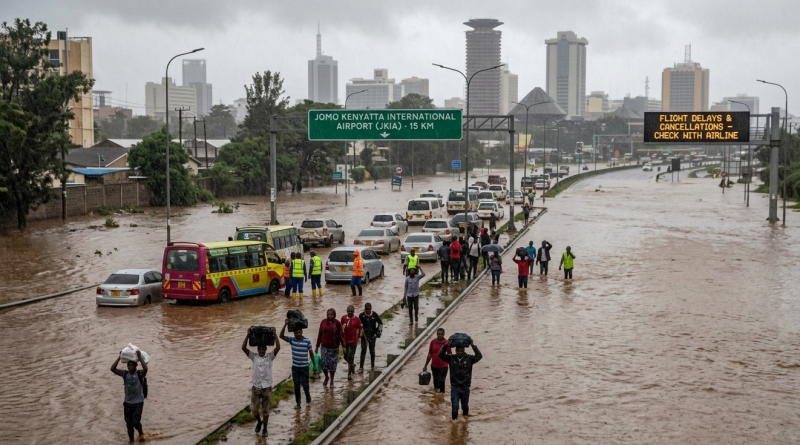
Authorities say hundreds of people have been rescued from submerged vehicles, rooftops and flooded homes since the storms began. Floodwaters also disrupted operations at Jomo Kenyatta International Airport, forcing some flights to divert as roads and infrastructure across Nairobi were inundated.
At least 172 vehicles were swept away or trapped in floodwaters, according to Public Service Cabinet Secretary Geoffrey Ruku, while large sections of road infrastructure across the capital were temporarily impassable.
In response to the disaster, President William Ruto ordered the release of emergency relief supplies from national reserves and pledged that the government would cover medical expenses for flood victims receiving treatment in public hospitals.
Beyond the fatalities, the floods have displaced tens of thousands of people nationwide, forcing many families to seek shelter in schools, churches and temporary evacuation centers.
Officials estimate that around 50,000 people have been affected, with thousands of homes damaged or destroyed as floodwaters swept through vulnerable communities.
Livestock losses and crop damage have also been reported in rural counties, raising concerns about the economic impact on farmers and food supply chains.
Scientists say extreme rainfall events are becoming more frequent in East Africa as global temperatures rise, intensifying storms and increasing flood risk.
A study by the World Weather Attribution initiative found that climate change has roughly doubled the likelihood of extreme rainfall events in the region.
Urban planners and environmental experts also point to rapid urbanization, blocked drainage systems and construction on flood plains as factors that worsen flooding in Kenya’s capital.
Nairobi’s drainage network, much of it built decades ago, has struggled to keep pace with rapid urbanization. The government says it has spent about KSh35 billion on flood-mitigation and drainage projects over the past four years, but the latest floods have triggered growing public calls for an audit into how funds allocated to storm-water infrastructure have been used.
Speaking during a televised interview on Sunday, Nairobi Governor Johnson Sakaja described the capital’s flooding challenges as the result of what he called a “generational infrastructure deficit.”
Sakaja said much of Nairobi’s underground drainage network was designed decades ago when the city’s population was around 500,000, compared with more than five million today. He estimated that a full overhaul of the drainage system would require between KSh25 billion and KSh30 billion, a sum he said the county government cannot finance under its current revenue structure.
“Nairobi cannot be organized and fixed using the same revenue model as other counties,” Sakaja said, calling for a special financing framework from the national government to support large-scale urban infrastructure projects.
Responding to criticism over the Sh35 billion reportedly spent on flood mitigation nationwide over the past four years, the governor said county budgets are largely absorbed by salaries and essential services, leaving limited funds for major engineering works needed to upgrade drainage systems.
He also urged residents to improve waste management practices, saying drainage channels are frequently blocked by illegally dumped plastic waste and construction debris despite efforts by the city’s 4,500-member “Green Army” cleanup workforce.
Authorities warned that the death toll could still rise as recovery teams continue searching flooded rivers and collapsed structures for missing persons.
With the long-rains season only beginning, disaster management officials are urging residents in flood-prone areas to relocate to safer ground and avoid crossing swollen rivers or driving through flooded roads.
For now, emergency services remain on high alert as the country waits for the storms to pass.