
A sudden boom at Lamu port — and the cost along the coast
By Chemtai Kirui | Lamu, Kenya
At first light in Manda Bay, the water looks undisturbed. Dhows move quietly across the channel, the tide slipping through the mangroves as it always has.
Further out, beyond the shallows, the horizon has changed.
The ships are back.
For years, the port of Lamu sat in uneasy stillness, its deep-water berths waiting on a promise that did not quite arrive. Built as part of the Lapsset corridor, it was meant to redraw trade routes across east Africa. Instead, it lingered in the shadow of Mombasa, handling modest cargo, its scale out of step with demand.
That changed in early 2026.
The surge was not driven by domestic growth or long-term planning. It came from disruption far beyond Kenya’s shores.
A sharp escalation of conflict in the Gulf has disrupted movement through the Strait of Hormuz, and has pushed shipping lines to look elsewhere. Routes have shifted. Insurance costs have climbed. In that disruption, Lamu has found its moment.
Insurance premiums for vessels entering the Gulf rose sharply, prompting operators to seek safer and cheaper alternatives along the east African coast.
What is unfolding in Lamu reflects a broader shift in global trade. Shipping routes are no longer organised purely around efficiency, but around risk — where vessels move not just to save time, but to avoid uncertainty.
The scale of the change is stark. In 2024, Lamu handled 74,380 metric tonnes of cargo. A year later, that figure had climbed to 799,161 tonnes — an almost tenfold increase.
By early 2026, the acceleration was sharper still. In the first weeks of the year alone, 74 vessels had already docked, matching traffic that once took years to build.
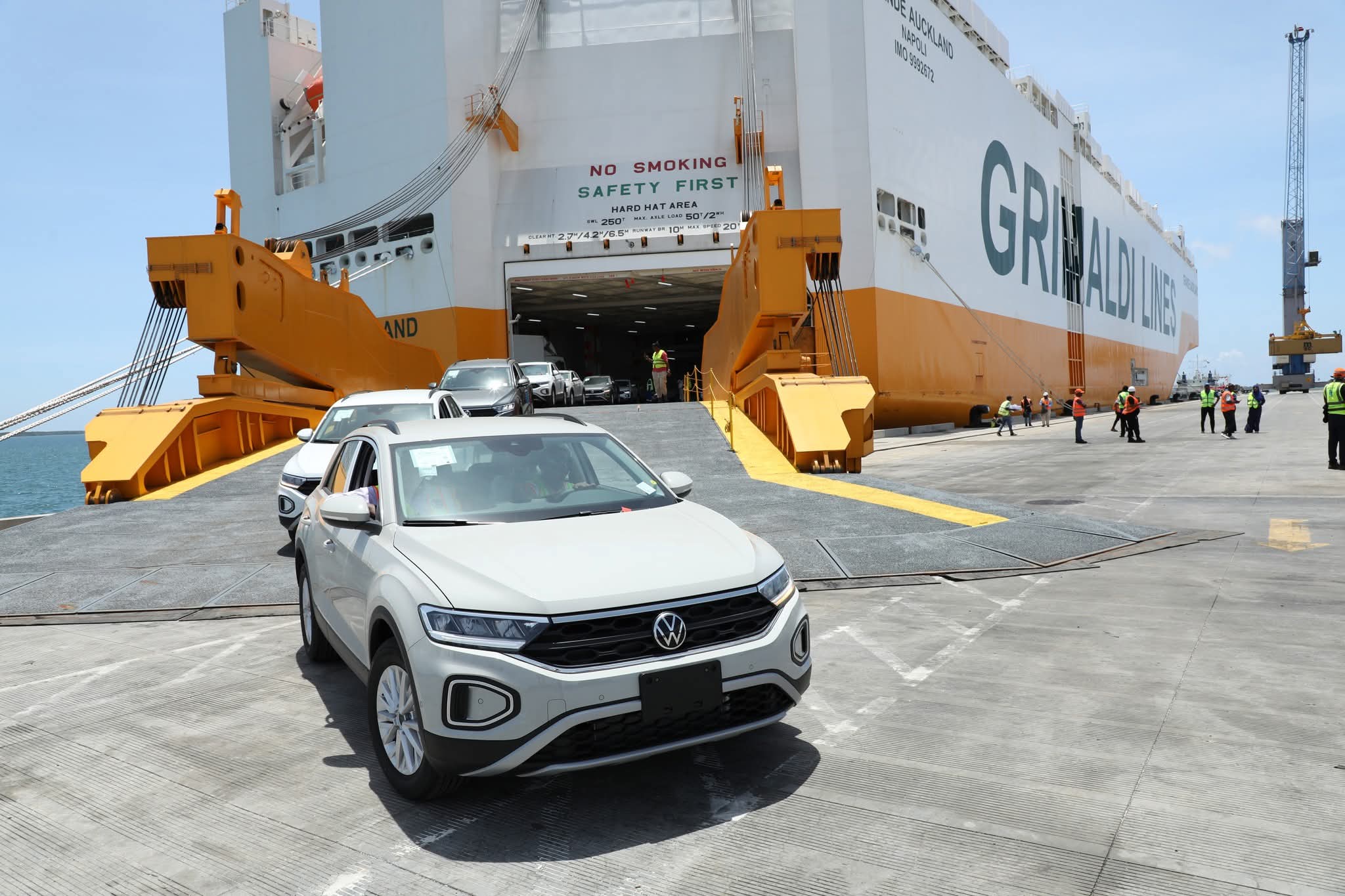
On 18 March, a car carrier offloaded about 3,800 vehicles originally bound for the Gulf — an early sign of how trade routes are being quietly redrawn.
Ships that once bypassed the Kenyan coast are now docking here, offloading cargo for redistribution inland or along alternative routes. Much of it is not destined for Kenya at all.
Instead, it sits — sometimes for weeks — waiting.
For many operators, Lamu has become less a gateway than a holding point. Extended storage terms and lower handling costs make it cheaper to offload cargo here than to keep ships waiting in uncertain waters.
In effect, the port is functioning as a floating warehouse.
For the government, the moment suggests vindication. For a project long criticised as premature, the numbers now tell a different story.
But along the shoreline, the picture is less certain.
To receive larger vessels, the channel into Manda Bay has been dredged deeper, cutting into the seabed to accommodate their draft. The work is largely invisible from the surface.
Its effects are not.
Kenya is already losing about 1% of its seagrass each year. In Manda Bay, researchers say dredging has accelerated that decline through what scientists describe as siltation-induced mortality — where suspended sediment settles over the seabed, blocking light and smothering marine vegetation.
Some of the species under pressure include Zostera capensis, listed as vulnerable, with scientists warning that increased sediment and underwater noise could push local populations towards collapse.
“Seagrass systems are extremely sensitive to disturbance,” says Dr Lilian Daudi of the Kenya Marine and Fisheries Research Institute. “Once sediment is suspended, it reduces light penetration and affects the entire ecosystem.”
Researchers describe the process as hydrological disruption — where natural tidal flows are severed. Without the daily movement of seawater, mangrove systems begin to dry out from within.
In places like Kitangani, that process has already taken hold. Channels are blocked, and stretches of mangrove have turned into what conservationists describe as sand graves.
Fishermen describe waters that no longer behave as they once did.
Seagrass beds, where fish spawn, have thinned. Coral systems are clouded by suspended sediment. In some areas, mangroves stand in patches of grey, their roots exposed where sand has shifted.
These losses extend beyond biodiversity. Mangroves along Kenya’s coast are among the most carbon-rich ecosystems in the region, storing large amounts of what scientists refer to as “blue carbon”.
In Lamu, researchers estimate these forests hold millions of tonnes of carbon. But when degraded, they risk releasing that stored carbon back into the atmosphere — turning a natural sink into a source of emissions.
For Mohamed Somo, a local fisheries leader, the change is measured in distance and time.
“You go further out now,” he says. “Sometimes you stay for days.”
“The fish are no longer here.”
Data collected by local beach management units shows a steady decline in catch per unit effort — a signal that breeding grounds are under strain.
The disruption is not new. In 2018, a court ordered compensation for thousands of fishermen affected by the port’s construction, recognising the loss of access to traditional fishing grounds. Payments followed in phases. But compensation has not restored the system that sustained those livelihoods.
“What we are seeing is development that extracts value without restoring what is lost,” says Khadija Shekuwe, a community advocate with Save Lamu.
What is emerging is a familiar pattern in large infrastructure projects: gains concentrated at the centre, costs absorbed at the edges.
The port’s current success also carries uncertainty.
Much of the traffic now passing through Lamu is not rooted in long-term demand, but in a temporary rerouting of global shipping. Analysts describe it as opportunistic — cargo finding the safest available path in a moment of geopolitical strain.
If those conditions shift, the traffic may move with them.
Without its full hinterland connections — particularly rail links into Ethiopia and South Sudan — Lamu remains partly disconnected from the markets it was designed to serve.
Its current role is less that of a destination than a stopgap.
Scientists warn that some of these changes may not easily be reversed. Alterations to the seabed and tidal systems can take decades to recover — if at all — meaning the ecological cost of the current boom could outlast the conditions that created it.
That tension — between immediate gain and structural limitation — sits at the centre of what is unfolding along this coast.
Because the port is working.
But it is working in a way that depends on forces far beyond it, while reshaping an ecosystem much closer to home.
Along the mangrove edge, the tide continues to move in and out, carrying silt, salt and whatever the channel releases into it.
The fishermen still set out each morning. The ships still arrive.
The question is how long this moment will last — and what will remain when it passes.